
 EN
EN
In any professional print production environment, efficiency depends on every stage of the finishing process working at its highest potential. The paper cutter sits at the center of that finishing workflow, determining how cleanly, consistently, and quickly trimmed output moves toward final delivery. Without a reliable paper cutter, even the most advanced printing press cannot guarantee a finished product that meets professional quality standards.
Modern print shops face growing pressure to reduce waste, tighten turnaround times, and maintain precise dimensional accuracy across every job. A high-performance paper cutter addresses all of these demands simultaneously. Whether handling short commercial runs or large-volume industrial output, the right paper cutter transforms print finishing from a bottleneck into a competitive advantage. Understanding why paper cutter systems are now essential helps production managers make smarter equipment investments.
The Role of the Paper Cutter in Print Finishing
Precision Cutting as a Quality Standard
Print finishing quality is ultimately judged by the final trimmed edge. A paper cutter with accurate blade positioning and consistent pressure delivers clean, sharp cuts that reflect professional production standards. When a paper cutter produces uneven edges or misaligned trims, the entire print run is compromised regardless of how well the printing was executed. Modern paper cutter systems use programmable back-gauge controls to eliminate manual measurement errors and ensure each cut matches exact specifications. This level of precision makes the paper cutter indispensable in any finishing workflow where quality matters.
Speed and Throughput in High-Volume Environments
A slow paper cutter creates downstream bottlenecks that delay packaging, binding, and delivery schedules. Today's paper cutter systems are engineered to process high stack volumes rapidly without sacrificing cut accuracy. Hydraulic paper cutter models, for example, apply consistent cutting force across thick paper stacks, allowing operators to cut more sheets per cycle. This throughput capability means a single paper cutter can handle the output demands of multiple printing lines when properly integrated into the production schedule. Faster paper cutter performance directly reduces cost-per-cut and improves overall facility output.
Key Efficiency Drivers in Modern Paper Cutter Design
Programmable Controls and Automation
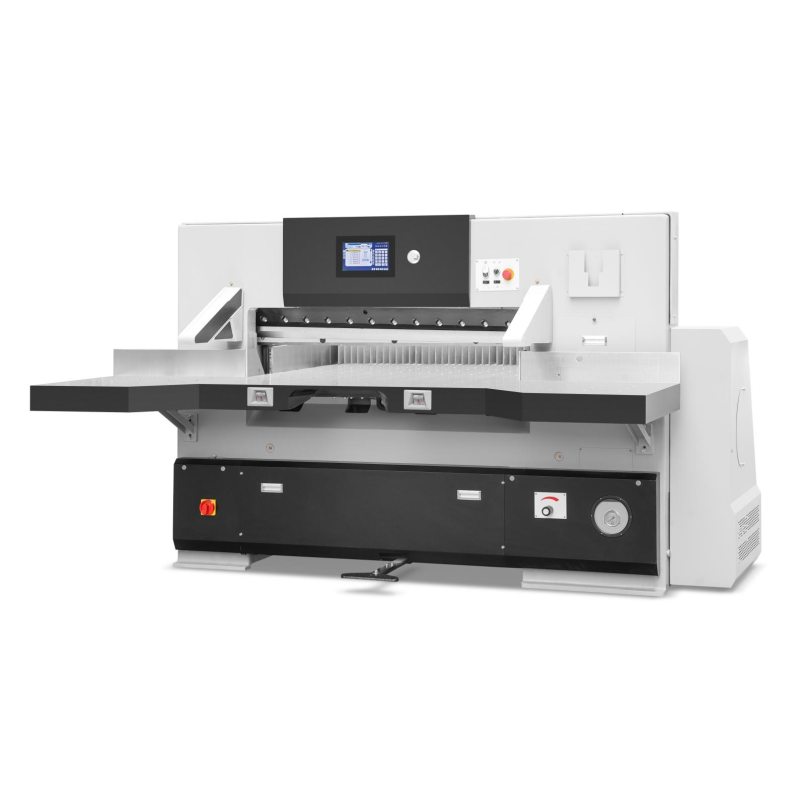
One of the most significant advances in paper cutter technology is the integration of programmable logic controls and digital interfaces. A modern paper cutter can store hundreds of cutting programs, allowing operators to switch between job specifications without manual repositioning. This automation reduces setup time between jobs, which is one of the largest sources of lost productivity in print finishing. When a paper cutter recalls a stored program, it repositions the back gauge automatically to the correct dimension, eliminating human error and reducing material waste. Programmable paper cutter systems also support consistent output quality across operators with varying experience levels.
Hydraulic Cutting Power and Blade Management
Double hydraulic paper cutter systems deliver balanced cutting force that extends blade life and reduces strain on the machine frame. When both hydraulic cylinders operate in synchrony, the paper cutter blade travels perpendicular to the paper stack, producing uniform cut quality from front to back. This balanced approach means the paper cutter experiences less mechanical wear compared to single-cylinder designs, reducing maintenance frequency and unplanned downtime. Blade management features, such as automatic blade angle adjustment, further enhance paper cutter performance by optimizing cutting geometry for different paper weights and stock types. A well-maintained paper cutter blade is one of the lowest-cost investments relative to the quality improvement it delivers.
Business Value of Investing in a Quality Paper Cutter
Waste Reduction and Material Savings
Every inaccurate cut from a paper cutter translates directly into wasted stock. When a paper cutter consistently produces off-dimension trims, print shops must recut or discard sheets, increasing material costs significantly over time. A precise paper cutter minimizes waste by delivering accurate cuts the first time, reducing the frequency of rejected output. Over a full production year, the material savings generated by a high-accuracy paper cutter can offset a significant portion of the equipment investment. For print businesses operating on tight margins, the paper cutter is one of the most financially impactful machines on the finishing floor.
Operator Safety and Ergonomic Design
Modern paper cutter systems are designed with operator safety as a priority. Safety features such as dual-hand activation controls, transparent blade guards, and emergency stop systems ensure that paper cutter operation meets current industrial safety standards. Ergonomic paper cutter designs reduce operator fatigue during long production shifts, which supports both productivity and workforce wellbeing. When a paper cutter is safe and comfortable to operate, staff confidence increases and error rates decrease. Investing in a safety-certified paper cutter also reduces liability exposure and demonstrates a commitment to responsible production practices.
FAQ
What types of jobs benefit most from a modern paper cutter?
Any print job requiring precise trimming benefits from a modern paper cutter, including brochures, business cards, books, packaging blanks, and promotional materials. High-volume commercial print runs gain the greatest efficiency advantage from a programmable paper cutter with hydraulic cutting power, since the combination of speed and accuracy reduces per-unit production costs substantially.
How does a hydraulic paper cutter differ from a manual model?
A hydraulic paper cutter uses pressurized fluid systems to drive the cutting beam with consistent, controlled force across the full width of the paper stack. This contrasts with manual paper cutter models, which rely on operator-applied mechanical leverage. The hydraulic paper cutter handles significantly thicker stacks, reduces operator effort, and delivers more uniform cut quality, making it the preferred choice for professional and industrial print finishing operations.
How often should a paper cutter blade be replaced or sharpened?
The blade replacement or sharpening frequency for a paper cutter depends on the volume of cuts performed, the types of materials being cut, and the blade steel grade. In a high-volume print environment, a paper cutter blade may require sharpening after every few thousand cuts to maintain edge quality. Most modern paper cutter systems include blade condition indicators or recommend scheduled maintenance intervals to help operators manage blade performance proactively.